

A human inspector can spot about 300 sweet potatoes per hour. By the third hour, fatigue sets in. By the sixth hour, the miss rate climbs. An AI optical sorter doesn't get tired. Here's why that matters for sweet potato packers.
The Problem with Human Inspection
Sweet potatoes are one of the most visually inconsistent crops in the produce aisle. Some are long and thin. Some are short and round. Some have rough, earthy skin. Some are smooth and polished. Colors range from deep orange to pale yellow to purple.
For a human inspector, this variety is exhausting.

The human eye is remarkably good at spotting defects — in the first hour. But by the second hour, the same eye starts to miss subtle cracks, early-stage rot, and color irregularities that blend into the natural variation of the crop.
By the end of a shift, a significant percentage of defective sweet potatoes have made it past inspection — not because the inspector was careless, but because the human brain wasn't designed to maintain the same level of visual attention hour after hour.
For packers supplying supermarkets or export markets, this is a risk. One defective sweet potato in a pack can trigger a complaint. A pattern of complaints can lose a customer.
The Alternative: Machine Vision That Never Blinks
An AI optical sorter does what humans can't: inspect every sweet potato, every time, with the same standard of accuracy.
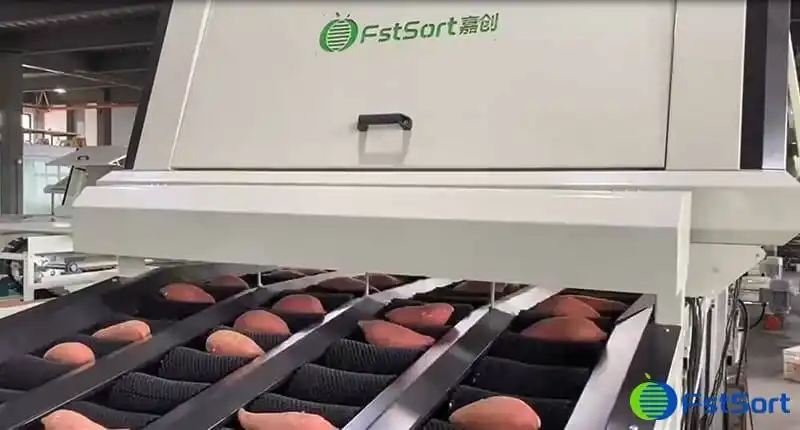
Fstsort's AI optical sorter uses a deep learning convolutional neural network (CNN) to analyze each sweet potato's surface. Two cameras per channel cover more than 85% of the surface — including the underside and edges that are hardest for human inspectors to see.
What Humans Miss | What the AI Catches |
|---|---|
Hidden cracks | Growth cracks that aren't visible from one angle but appear when the sweet potato rotates |
Early-stage rot | Spots that haven't yet changed color enough for the human eye to flag |
Subtle discoloration | Color variations that blend into the natural range of the variety |
Foreign objects | Stones, stems, and mud clumps that look like sweet potatoes to a tired eye |
The system runs continuously — no breaks, no fatigue, no shift change. Every sweet potato receives the same inspection, whether it's the first of the day or the ten-thousandth.
What the AI Can Detect
The Fstsort AI optical sorter is trained to recognize everything that can turn a premium sweet potato into a rejected one. Instead of applying a single rule to all sweet potatoes, the AI learns to distinguish between natural variation and actual defects for each variety you process.
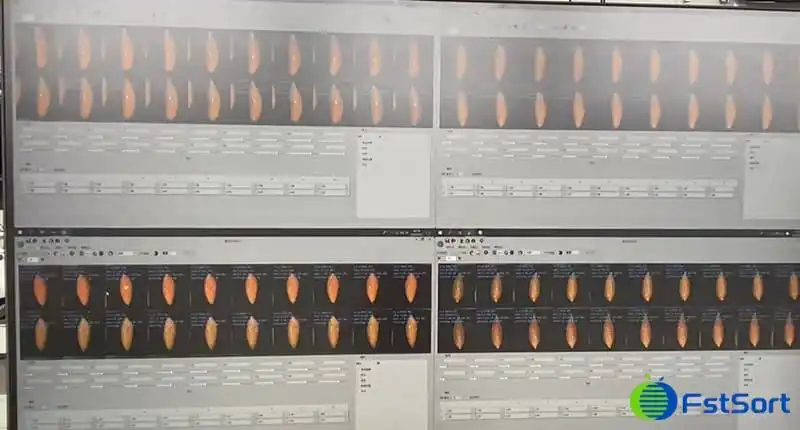
The AI separates acceptable products from defects based on:
· Surface condition — cuts, scrapes, impact marks that make sweet potatoes look rough and unappealing
· Signs of decay — rot, discoloration, and softening that indicate spoilage
· Structural integrity — cracks, rust spots, and deformities that affect marketability
· Purity — mud, stones, leaves, and other foreign material that shouldn't be in the final pack
· Color consistency — blemishes and uneven coloring that vary by variety but signal poor quality to buyers
· Any other condition you define — the AI system can be trained to identify whatever quality issues your buyers won't accept
No matter how much variation exists in your sweet potato crop, every single piece is evaluated against your specific quality standards — not a generic set of rules.
3–18 Tons Per Hour — At Your Scale
The Fstsort AI optical sorter processes 3 to 18 tons per hour, depending on the number of channels (1–6). Each channel operates independently, allowing you to scale capacity as your volume grows.
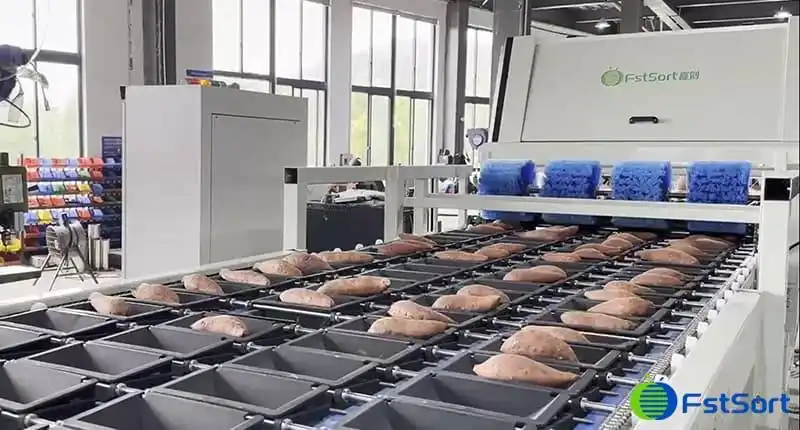
Dynamic weighing delivers accuracy with error under ±2g. The sorter can be placed upstream after washing, or downstream as a final quality check before packaging — integrating seamlessly into existing lines.
Export markets are demanding. European and Asian buyers reject shipments that contain even a small percentage of defective sweet potatoes. The margin for error is thin.
Want to know more about optical sorting machine? Explore our sweet potato washing, drying & sorting line page →
Human Eyes Are Good. They‘re Just Not Enough.
Human inspectors are skilled. They're experienced. They care about quality. But they're also human — and humans get tired.
AI doesn't make mistakes from fatigue. It doesn't miss defects because it's distracted. It applies the same standard to every sweet potato, hour after hour.