
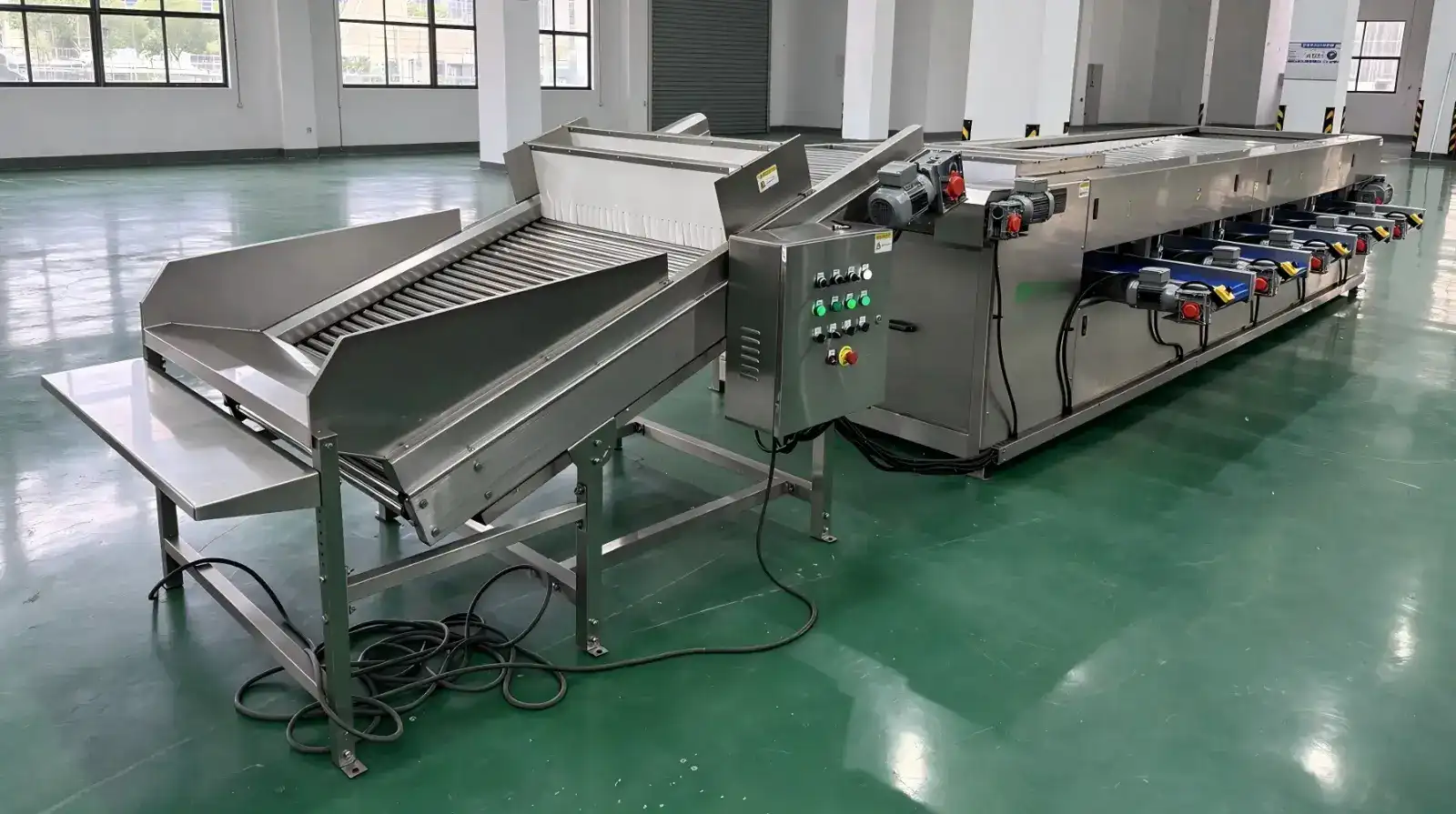
Live snails have thin shells and are easily stressed during grading, while export specifications remain strict. Fstsort roller grader uses gentle cradling and physical gap sizing to protect shells, maintain live condition, and ensure consistent grading.
Live Snail Grading Is Not the Same as Crayfish Grading
Snails are evolving from a regional ingredient into a global commodity. The global snail market was valued at approximately $420 million in 2025 and is projected to reach $703.9 million by 2035, at a CAGR of 5.3%. Live snails account for 45% of the market, making them the largest product form, with food applications representing about 70% of overall demand.
Asia-Pacific is the core region for snail trade. Indonesia accounts for 48% of Asia-Pacific snail exports, serving as the regional export hub; import demand from China, Japan, and Australia continues to grow, potentially faster than regional production, supporting firm prices for export-grade products.
But there is an underappreciated step in live snail exports: grading.

Three Challenges in Live Snail Grading
1. Thin shells—grading itself is a damage source. Snails have low mechanical strength, and shells are especially fragile before the lip forms. Rolling and dropping during grading can cause shell cracks—and once the shell breaks, both commercial value and survival rate drop.
2. With live snails, it’s not just the shell at stake. Snails are typically transported in a hibernated state, and prolonged tumbling and mechanical stress during grading can disrupt hibernation and raise post-arrival mortality. Industry research also notes that extended rolling is detrimental to survival—equipment must not only "move snails through" but "move them through gently."
3. Specifications must match export standards exactly. Snails are graded by shell diameter or count per kilogram—6–8g corresponds to 130–160 pieces/kg, 8–10g to 100–130 pieces/kg, with strict boundaries. Manual grading relies on handfeel and visual judgment, and different workers may produce different results for the same batch.
Fstsort Roller Grader for Snails: Responding to Live Grading with "Gentle" and "Accurate"
Fstsort roller grader is designed to be suitable for snail grading. Its logic is not to "push snails through the grading section as fast as possible," but to let each snail be placed into the correct specification with minimal damage.
1. Gentle cradling: no throwing, no squeezing during grading
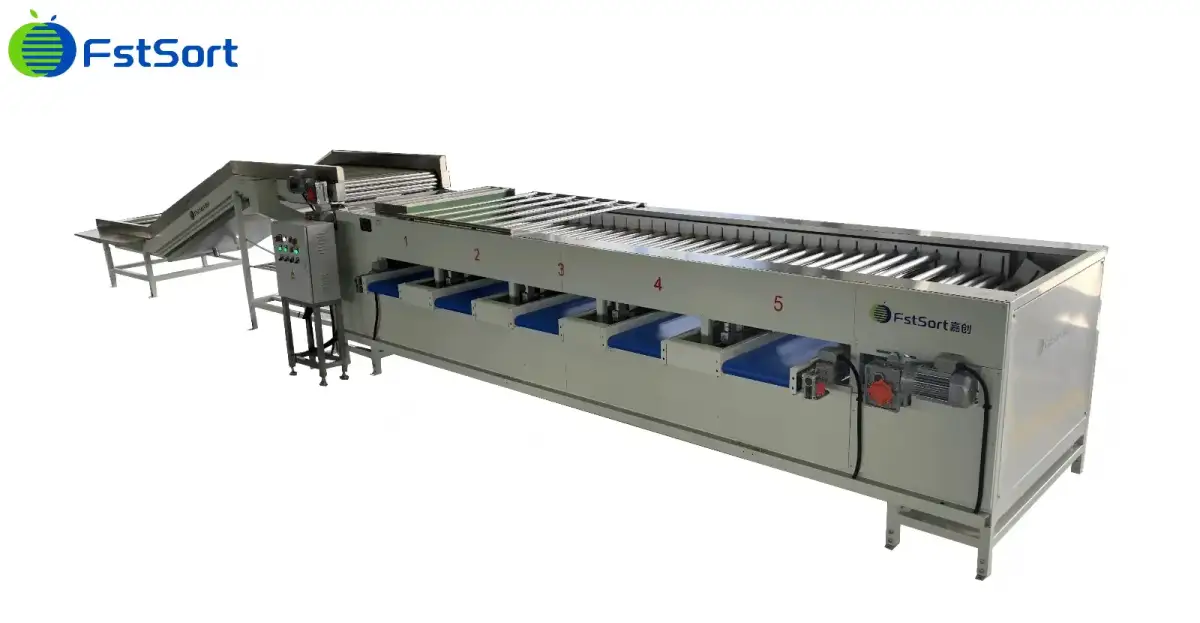
The roller grading section uses physical gap-based sizing—snails move steadily forward on the rollers and fall naturally through the gap that matches their shell diameter, rather than being forced, pushed, or thrown. For live snails with thin shells and low mechanical strength, this physically reduces the sources of shell damage and stress. The goal is not to "get snails through quickly," but to "get snails through intact."
2. Physical size determines grade: specifications set by gaps, not by handfeel
Shell diameter or weight specifications are determined directly by the physical dimensions of the roller gaps—the grade boundaries corresponding to export standards are fixed in the gap settings and do not drift with worker fatigue or experience. For the same batch, grading results are consistent; for different export markets, adjusting the gap configuration adapts the machine to different specification requirements. “Accurate” here does not mean speed—it means every snail ends up in the grade it belongs to.
3. Flexible adaptation: from snails to crayfish, the same roller-grading logic works across categories
Fstsort’s roller grading platform has accumulated practical operating experience in seafood categories—the roller/drum gap-based grading principle is equally applicable to crayfish and other crustaceans, with a capacity of approximately 2 tonnes per hour. For processors handling both snails and crayfish, this means equipment utilization is not limited to a single category, and seasonal switches do not require purchasing an entirely new grading line.
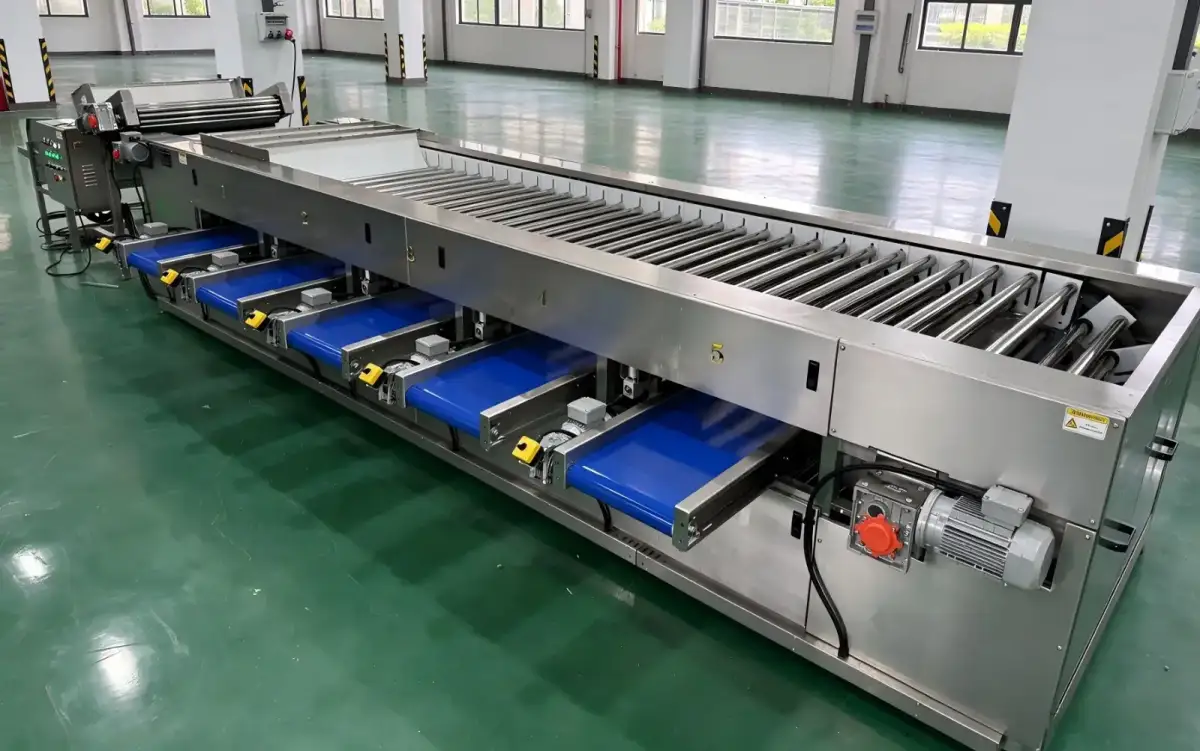
Key Capabilities Overview
Capability | What it means for live snail grading |
|---|---|
Roller physical gap-based grading | Shell diameter maps to grade; specifications locked by gaps, not manual handfeel |
Gentle cradling structure | Reduces shell damage and mechanical stress during grading, protecting live condition |
Adjustable gaps | Adapts to different export market shell-diameter/weight specifications |
Cross-category application | Shared roller platform for snails, crayfish, and other seafood, improving equipment utilization |
Reference capacity | 2 t/h |
From Grading Machine to Complete Live Snail Export Quality Control
Grading is just one step in the live snail export chain. The hibernation preparation, packing, and cold-chain transport that follow grading all affect final survival rates and arrival quality. Fstsort's roller grading equipment can connect with upstream and downstream processes to form a continuous grading → hibernation preparation → packing flow, reducing manual handling and secondary stress after grading.
Competition in live snail exports is shifting from "having supply" to "arriving alive, and in the right size." When buyers receive goods against strict shell-diameter and count-per-kilogram standards, shell protection and sizing precision at the grading stage directly determine whether exporters can carry the live snail premium all the way to destination.
Want your live snail grading to achieve "no shell damage, accurate sizing, stable condition" ? Learn more about Fstsort's roller grader suitable for snail grading→