

Onion buyers set strict diameter specifications, often down to the millimeter—yet sorting must move fast without bruising the crop. This article examines the trade-off between speed and accuracy, and how Fstsort's onion sorting machines deliver both through physical size grading.
The "Fast" in Onion Sorting Cannot Come at the Cost of "Damage"
Onions are among the most heavily traded vegetables. Global onion exports were worth about $4.13 billion in 2025, with yellow onions accounting for roughly 87% of production. Market diameter requirements are precise to the millimeter—Australian loose onions 60–75 mm, prepacks 45–60 mm, pickling onions 35–45 mm.
Export buyers do not relax specifications because sorting is "fast." Sorting must meet two conditions at once: speed that keeps pace with delivery, and accurate sizing without damaging the bulbs.
But there is a real tension between "fast" and "without damage."

Traditional Sorting Is Stuck Between Fast and Accurate
· Manual sorting: accurate enough, but not fast and not consistent. Workers judge by eye and experience; accuracy varies with fatigue and individual differences, and the same batch can be graded differently by different workers.
· Conventional mechanical sorting: fast, but potentially "fast with damage." Drum or roller graders tumble and drop onions far faster than manual labor. But research shows damage rates depend heavily on equipment parameters—0.34%–1.20% in optimized systems versus 2.26%–7.93% in unoptimized ones. "Fast" is not the problem—"how you achieve fast" is.
Onion bruising and skin damage are often invisible at sorting, only appearing during storage or transport—the exporter discovers the loss when the shipment arrives and the grade has dropped.
Fstsort Onion Sorting Machines: Fast and Accurate Through Physical Principles
The design logic of Fstsort's onion sorting machines is not "make onions roll faster"—it is to let size be determined at the physical level, and to let each bulb complete grading with minimal damage.
1. Size is decided by gaps, not by speed
Whether a roller grader or a drum grader, the core principle is the physical dimension of the rollers or holes—as onions move forward, they fall through the gap or aperture that matches their diameter. Size judgment does not depend on workers' eyes, nor on how fast the machine runs. This means capacity can be raised without the grading standard drifting.
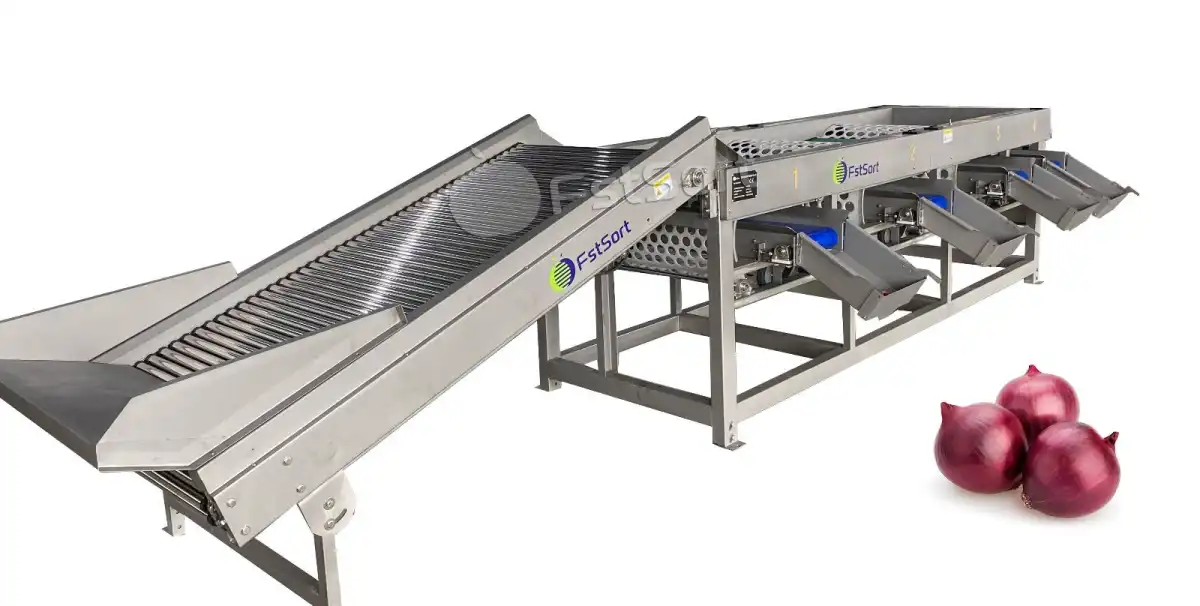
2. Gentle handling: roller grading reduces bruising for round/oval onions
Roller graders are suited to round/oval yellow and white onions, with the core advantage of gentle handling and reduced bruising. Onions move forward on the rollers and fall naturally, rather than being squeezed or thrown. For thin-skinned, bruise-prone yellow and white varieties, letting gravity do the grading is a more damage-conscious approach than aggressive mechanical sorting with unoptimized settings.
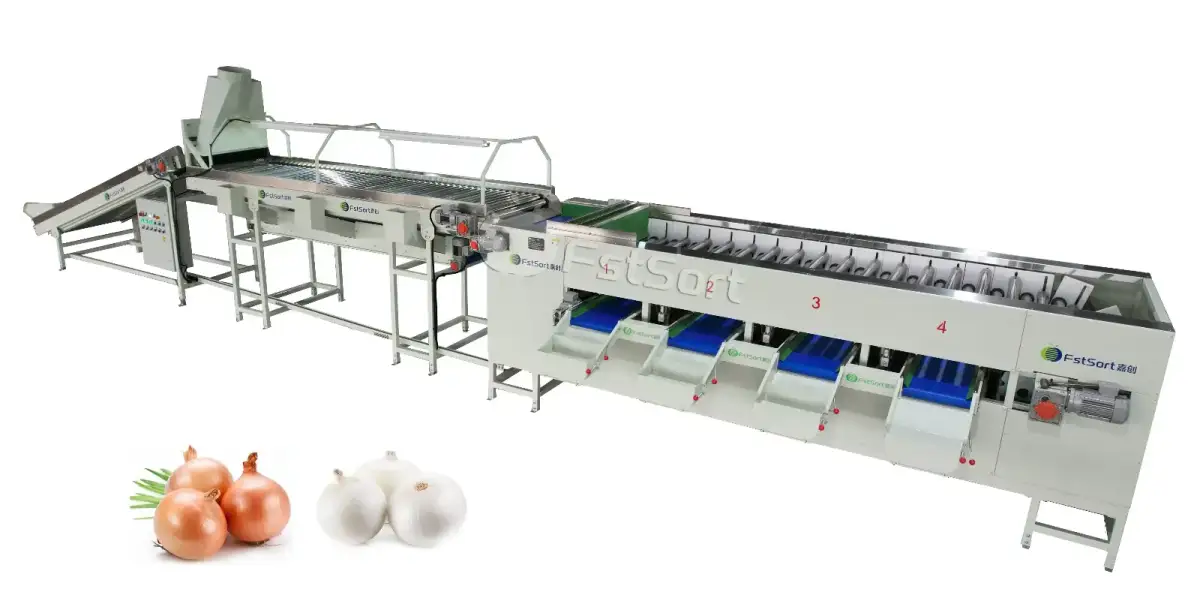
3. Integrated quality control: remove debris and defects before grading
Fstsort's onion sorting line places air classification and a roller inspection conveyor before the grading section—air removes soil and loose skins, while the inspection table lets workers remove rotten, diseased, and out-of-spec bulbs. This means onions entering the grading section are already clean and acceptable; the grader only needs to judge size, rather than "sort and inspect at the same time," improving both efficiency and precision.

Key Capabilities Overview
Capability | What it means for "fast" and "accurate" |
|---|---|
Roller/drum/screen physical grading | Size standard set by gaps, does not drift as capacity rises |
Gentle roller handling | Suited to round/oval yellow & white onions, reduces bruising |
Capacity from 6–8 t/h to 15–20 t/h | Matches different export processing rhythms |
From Sorting Machines to Complete Export Solutions
Sorting is just one step in onion post-harvest handling. Fstsort offers complete onion processing solutions covering infeed, air classification, manual inspection, size grading, and bagging/boxing—graded onions can go directly into net bags, woven bags, or cartons, reducing re-handling damage between stages.
Competition in onion exports is shifting from "having supply" to "every bag being accurately sized." When buyers receive goods against millimeter-level diameter standards, sizing precision and damage control at the sorting stage directly determine whether exporters can deliver consistently and hold their price.
Want your onion sorting to be "fast without damage, fast and precise"? Learn more about Fstsort's onion sorting machines→