
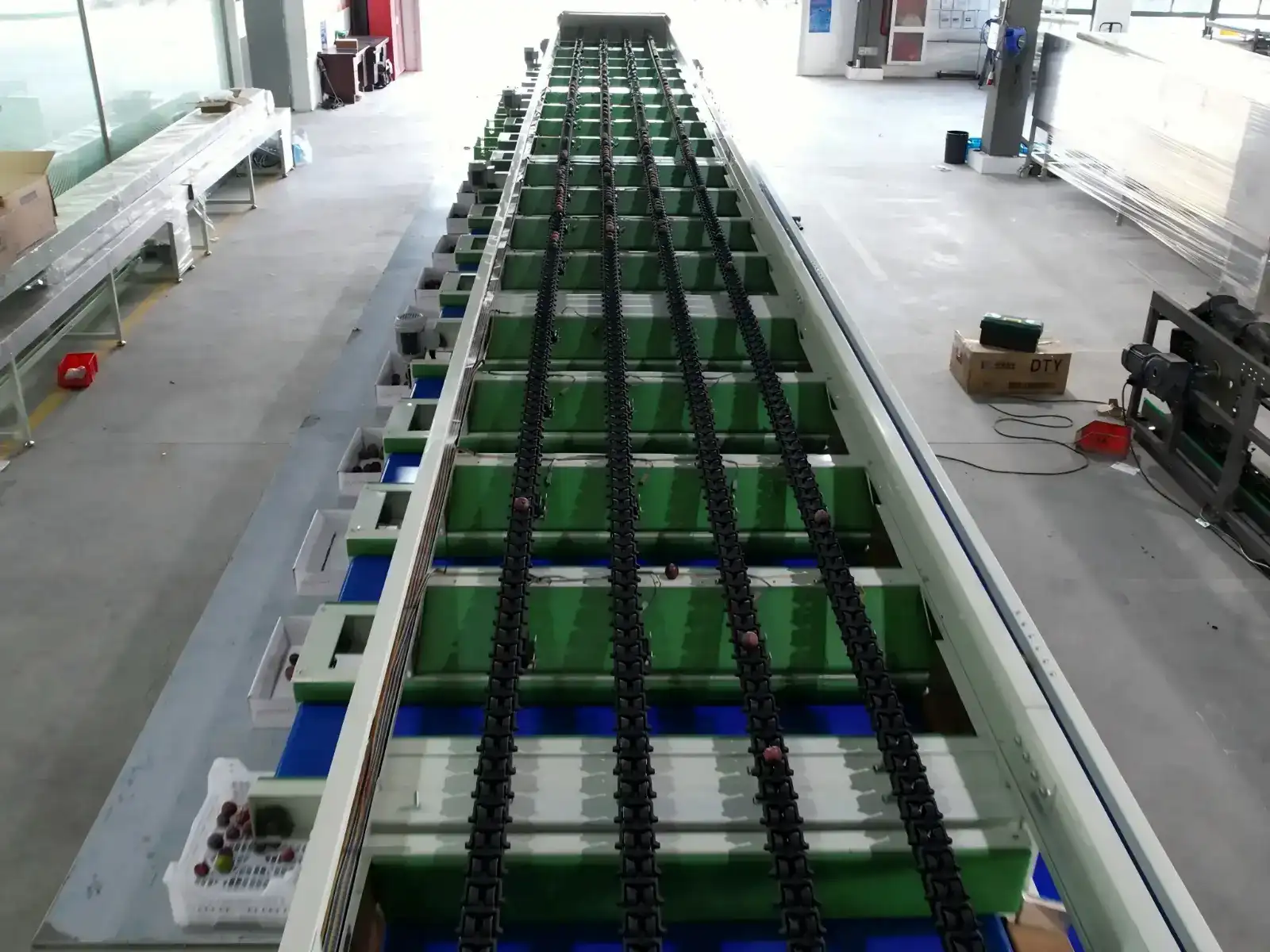
Plum grades are defined mainly by weight, but plums are small and adjacent grades differ only slightly—manual visual grading and diameter sorting both struggle to be precise. After expanding, Chengdu Xinhongyang Agriculture replaced rough manual work with Fstsort's four-lane weight lines: 50 people now handle what previously took over 100, with better uniformity and consistency. This article examines the weight logic of plum grading and how four-lane sorting turns "grading by weight" into a repeatable standard.
Plum Grading: Sorting by Weight, Not by "How Big It Looks"
Plums are a fruit that "looks similar but is actually quite different." The fruit is small, and the size difference between adjacent grades is minimal—manual visual judgment and handfeel cannot reliably distinguish them. What the market and processing side actually care about is individual fruit weight, which directly maps to yield, dry matter content, and final pricing.

Manual sorting has a structural limitation here. Workers must repeatedly pick up, weigh, and put down each plum—slow, inconsistent across workers, and the repeated handling itself creates additional contact and damage. Plum post-harvest losses run at 25–40%, with physical damage during sorting and packing reaching 28% and bruising 24%. When it comes to "grading by weight," manual methods are neither accurate enough nor consistent enough.
The Customer's Choice: From "Rough Production" to "Grading on the Line"
Chengdu Xinhongyang Agriculture Co., Ltd. was established in January 2015 in Pengzhou, Chengdu. It operates the Xinhongyang Warehouse Cold Chain Distribution Center, covering 10,000 square meters, and is a professional agricultural service provider integrating procurement, pre-selection and grading, processing and packaging, and cold-chain distribution.
As the business expanded, Mr. Wu, the company's head, recognized a problem: the original rough production model had high labor intensity and low efficiency, and there was no unified standard from variety selection through planting to finished product sorting. That "lack of standard" ultimately reached the sales terminal as consumer confusion and inconsistent quality.
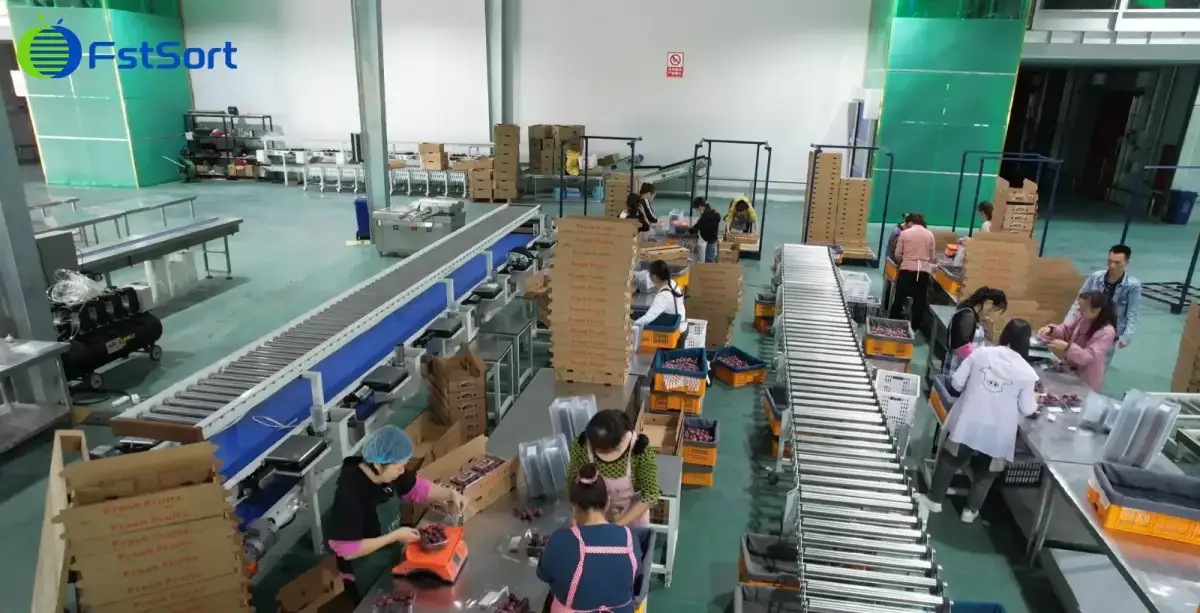
Xinhongyang chose Fstsort's four-lane sorting lines—four of them. After commissioning, cleaning, sorting, and packing run smoothly on the line, with fruit weight and size automatically identified. More than 50 people now complete the workload that previously required over 100, saving 50% in labor costs. More importantly, the four lines make plum sizing more uniform and quality more stable—"uniform" and "stable" are promises that are very difficult to make under manual sorting.
The Four-Lane Weight Line: Turning "Grading by Weight" into a Standard Operation
Fstsort's electronic weight sorting line for plums consists of an elevator, roller inspection table, V-belt, and weight grader, sorting by weight rather than diameter. Its design logic can be understood through three practical constraints of plum grading.
1. Grade by weight, not by "how big it looks"
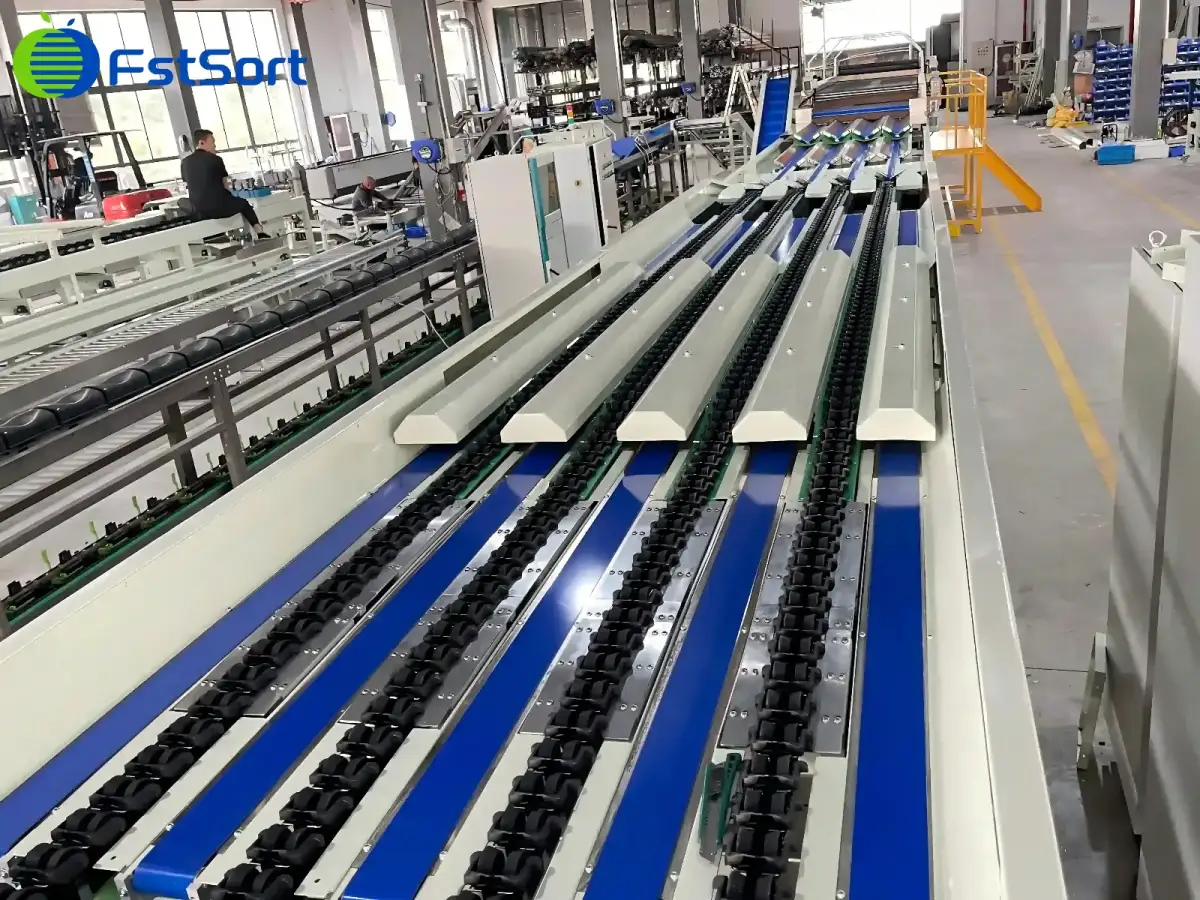
Each weighing cup measures individual fruit independently with ±2g accuracy, and the control system routes the plum to the corresponding outlet based on preset weight ranges. The grading standard is set by weight data, not by visual diameter judgment—for plums where the size difference between adjacent grades is minimal, weight is a more reliable basis for grading than diameter.
2. Four lanes in parallel: matching the concentrated rhythm of plum season
Plum harvest and processing windows are concentrated, and a single lane must handle large volumes in a short period. Four lanes running in parallel mean four independent weighing and grading paths operating simultaneously, with 9 to 16 configurable exits, matching capacities from small and medium processing to large-scale lines. For a service provider like Xinhongyang that covers procurement, grading, packing, and cold-chain distribution, four lanes are not "overkill"—they keep grading from becoming the bottleneck of the entire chain.
3. Inspection table upstream: remove substandard fruit before weighing
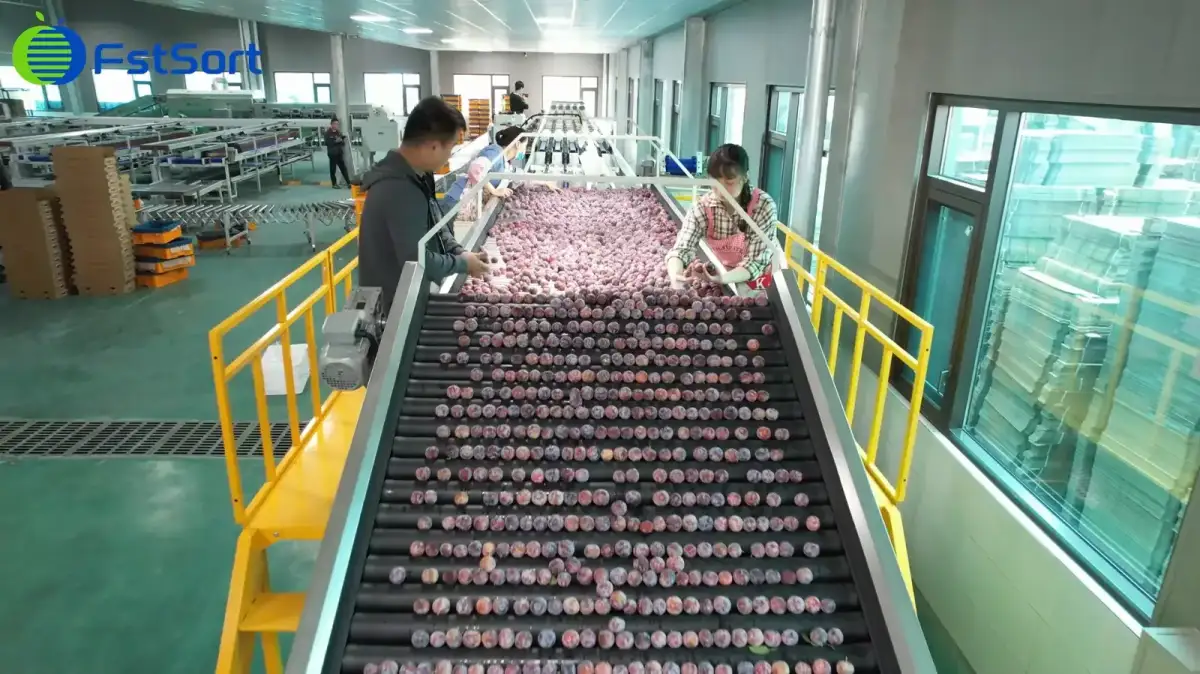
The line places a roller inspection table before the weighing and grading section. Workers remove diseased, damaged, and out-of-spec fruit here, then fruit moves into the V-belt and weight grader. The sequence matters: substandard fruit should not consume grading capacity, and already-damaged fruit should not go through another unnecessary handling step during weighing. Inspection and grading are separated, rather than mixed together and left to the same person.
From Four Lines to a Replicable Grading Standard
Xinhongyang's four four-lane lines ultimately deliver more than "saving 50 people." They turn plum grading from "depending on the handfeel of experienced workers" into a standard that can be written into operating procedures, replicated across batches, and expanded by adding lines as business grows. When the business continues to grow, what needs to be added is not "more experienced workers," but "lines with the same configuration"—the standard does not walk out the door when people leave.
Competition in plum grading is shifting from "whether there are enough hands to sort" to "whether every batch has stable weight grades." As manual visual judgment struggles between adjacent grades and terminal demand for uniformity and consistency rises, the four-lane weight line offers not "faster sorting," but a path that makes "grading by weight" consistently executable.
Want your plum grading to move from "handfeel" to "executing a weight standard"? Learn more about Fstsort's four-lane weight sorting lines and plum grading solutions→