

Pomegranates look tough, but the arils inside bruise invisibly—mechanical damage causes over 37% of packhouse losses, while export buyers demand 9–12 weight grades. This article examines the “tough skin, fragile inside” paradox and how Fstsort’s linear weight sorter uses soft cups, low-drop discharge, and ±2g accuracy to reduce bruising and standardize grading.
Pomegranate Exports Are Growing—But Tolerance for Bruising Is Shrinking
Pomegranates are among the fastest-growing categories in high-value fresh fruit trade. The global pomegra
nate market was valued at approximately $273 million in 2025 and is projected to reach $389 million by 2032, at a CAGR of 5.3%. India’s pomegranate exports grew 21% year-on-year in FY 2024-25, and the global market is projected to reach $7.09 billion by 2027.
Export volumes are rising, but the bar is rising too. Buyers—especially premium channels in China, Europe, and the Middle East—require fruit to be graded into 9–12 fine weight grades to separate market tiers. A single misgraded fruit in a shipment can trigger a price reduction—or a full rejection.
The problem is that pomegranate’s thick skin creates an illusion of durability. The reality is the opposite.
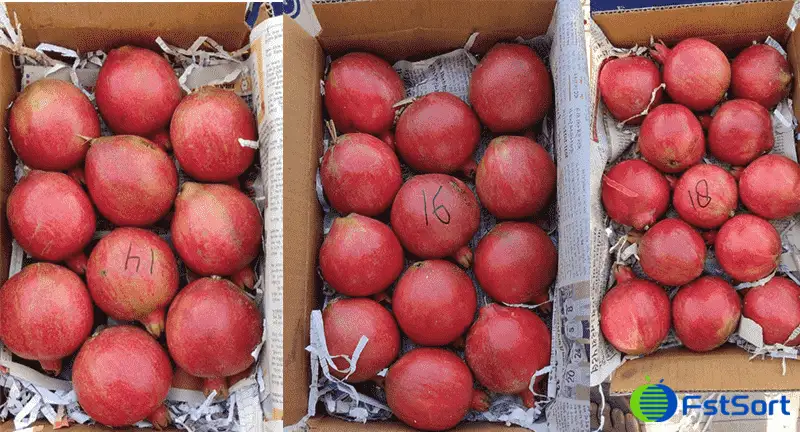
The Core Contradiction in Pomegranate Sorting: The Thicker the Skin, the Deeper the Hidden Damage
· Bruising is invisible, but the consequences are severe. The rind is thick, yet the arils inside are extremely delicate. Drops, tumbling, and compression during sorting cause bruising beneath the skin—while the fruit looks perfectly intact outside. By the time the consumer opens it, the arils have discolored and softened, and the fruit’s commercial value is gone.
· Traditional sorting methods are part of the problem. Manual sorting requires repeatedly picking up, turning, and putting down each fruit—every contact is a potential impact. Roller grading and roller-gap grading move fruit through rolling, tumbling, and dropping through gaps—fast, but every roll and drop accumulates hidden damage.
· Export tolerance is approaching zero. Buyers receive fruit by weight grade, with 9–12 grades mapping to different markets. One misgraded fruit can get an entire shipment discounted or rejected. Manual sorting standards vary by worker; traditional mechanical sorting handles size but not bruising.
Fstsort Linear Weight Sorter: Every Pomegranate “Sits to Be Weighed, Lands Softly”
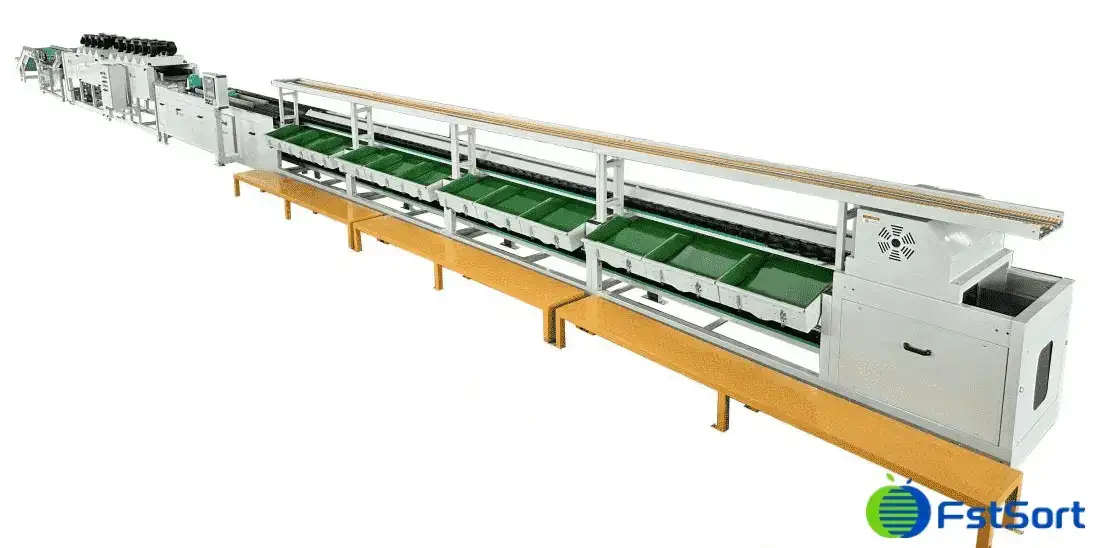
The design logic of Fstsort’s linear weight sorter is not “sort pomegranates faster”—it is to physically eliminate the conditions that cause bruising. Three core designs address the three stages where bruising occurs:
1. Soft weighing cups: the fruit sits still during weighing—no rolling, no tumbling
Traditional sorters move fruit through rolling or tumbling during weighing, creating continuous friction and micro-impacts between the skin and the equipment. Fstsort uses soft weighing cups—each pomegranate is cradled stationary during weighing, with no rolling, no tumbling, and no fruit-to-fruit collision. Weighing itself is no longer a damage stage.
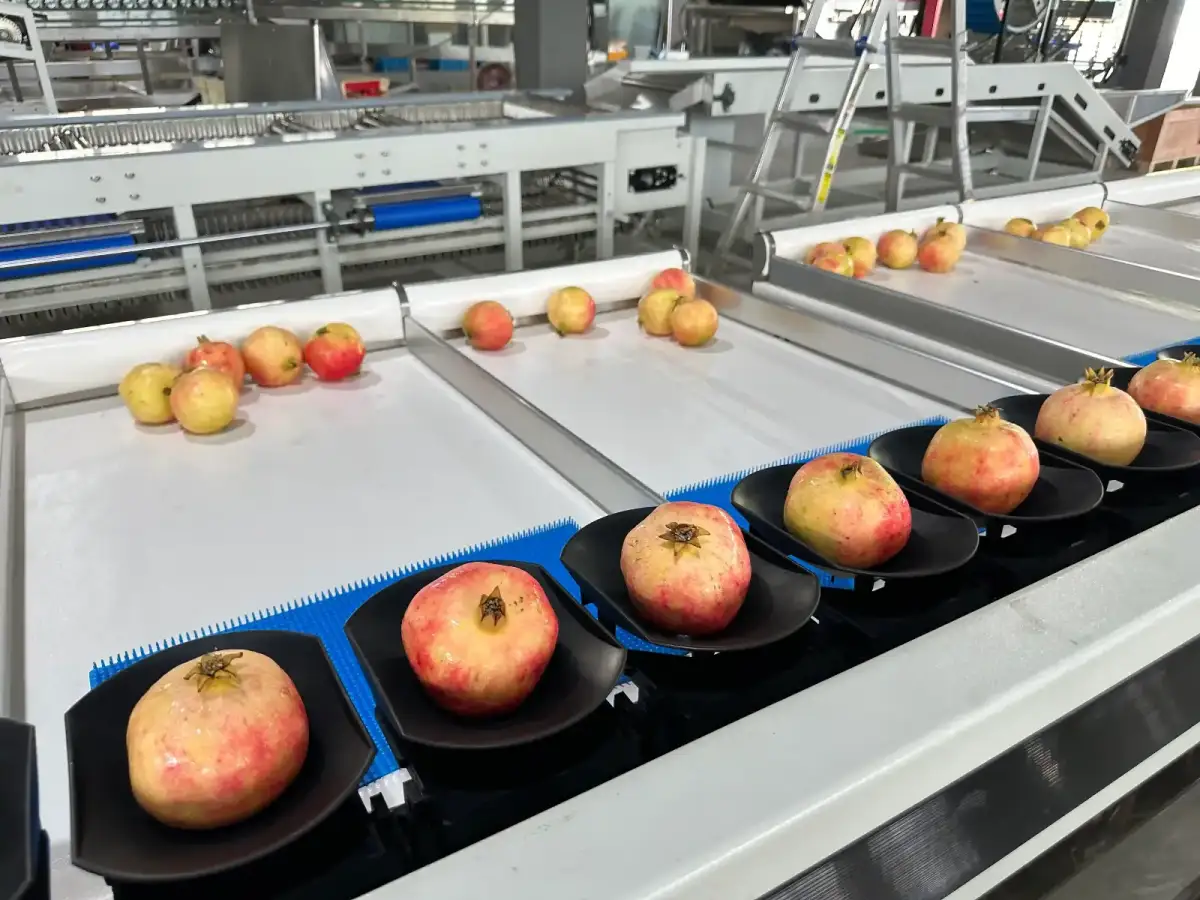
2. Low-drop design: at the discharge point, fruit is lowered—not dropped
The most common bruising point in a sorter is not weighing—it is the discharge. Fstsort’s low-drop design minimizes the fall height at every outlet, so fruit leaves the machine in a motion closer to “being set down” than “being dropped”.
3. Individual weighing at ±2g: fixed standards, no human error
Each pomegranate is weighed individually with ±2g accuracy and automatically diverted to its preset weight grade. Grading standards are set by PLC—no fatigue, no experience-based variation. One machine can store multiple grade profiles: a 9–12 grade scheme for China, another for Europe, switchable without hardware changes.
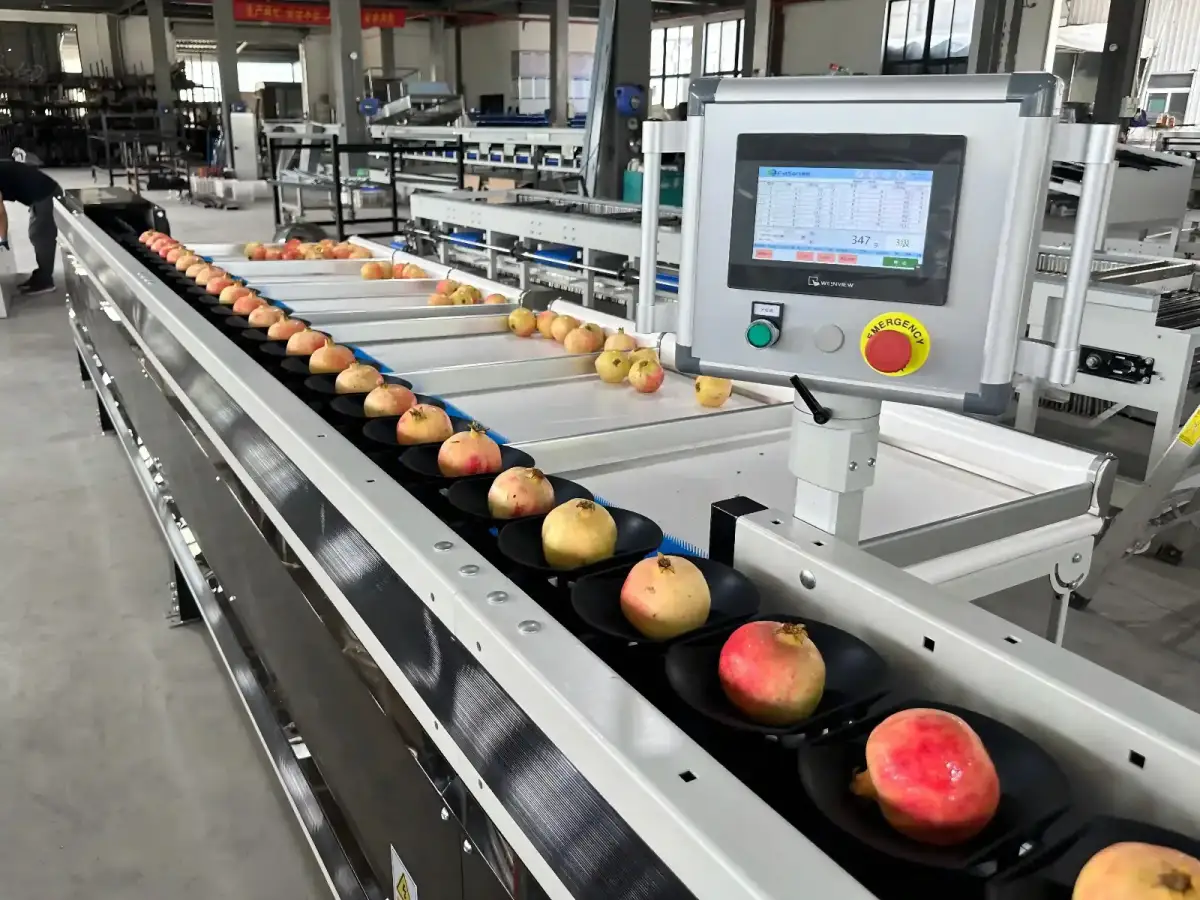
Together, these three designs answer one question: the goal is not just to “finish sorting,” but to “finish sorting with every fruit still intact.”
Key Specifications Overview
Parameter | Specification |
|---|---|
Sorting method | Linear weight sorting |
Weighing accuracy | ±2g |
Sorting grades | 3–12, adjustable |
Protective design | Soft weighing cups, low-drop discharge |
Grade switching | PLC-stored profiles, switchable by market |
Lane configuration | 1/2/4 lanes (selected by capacity) |
Applicable products | Pomegranate, apple, pear, citrus, and other fragile fresh fruit |
From Sorter to Complete Export Solution
Sorting is just one step in pomegranate post-harvest handling. Fstsort offers complete pomegranate processing solutions covering infeed, washing, drying, weight sorting, and packing—washing and drying are also designed around “no damage to the fruit,” forming a continuous quality-control loop from cleaning to grading alongside the linear weight sorter.
Competition in pomegranate exports is shifting from “having supply” to “having consistent supply.” When buyers demand 9–12 fine grades and a single bruised fruit can drag down an entire shipment’s price, bruise control and specification consistency at the sorting stage are becoming the critical variables that determine whether exporters can protect their premium.
Want your pomegranate sorting to move from “sorting fast” to “sorting accurately, without hidden damage”? Learn more about Fstsort’s linear weight sorter→