

The global persimmon market was valued at approximately $4.8 billion in 2025, with export prices up 2.3% year-on-year. But persimmons are highly prone to mechanical damage, which directly triggers flesh browning—a leading cause of post-harvest loss. The industry mainly uses weight sorting and optical sorting. This article examines what each method solves and where each fits.
The Core Contradiction in Persimmon Sorting: The More Valuable, the More Fragile
The global persimmon market was valued at approximately $4.8 billion in 2025 and is projected to reach $5.8 billion by 2032, at a CAGR of 2.5%. China accounts for about 75% of global production. Global exports stand at approximately 350,000 tonnes, with an average export price of $1,094 per tonne in 2024, up 2.3% year-on-year.

But the more valuable persimmons become, the more fragile they are on the sorting line. Persimmon is a soft fruit, and mechanical damage is a decisive factor in flesh browning—a main cause of post-harvest loss. A knocked persimmon may look intact outside while browning has already begun inside—invisible at sorting, only showing up on the shelf.
Manual sorting pressure is also mounting. A Nara, Japan demonstration showed manual sorting required 48 workers; automated sorting reduced that to 8—a cut of over 80%—while improving capacity by 20%.
Method 1: Weight Sorting—Trading "Contact" for "Consistency"

Weight sorting is the most basic and widely used method: each fruit is weighed and routed by preset ranges (e.g., >200g, 150–200g, <150g).
Its value is not "the gentlest handling," but achieving specification consistency with acceptable contact. For budget-conscious packers serving standard markets, it is simple, easy to maintain, and cost-effective.
But it is contact-based: weighing, conveying, and discharge all involve contact and drops. For fresh export, premium channels, or very soft varieties, that contact is itself an injury risk.
Method 2: Optical Sorting—Trading "Non-Contact" for "Seeing the Invisible"
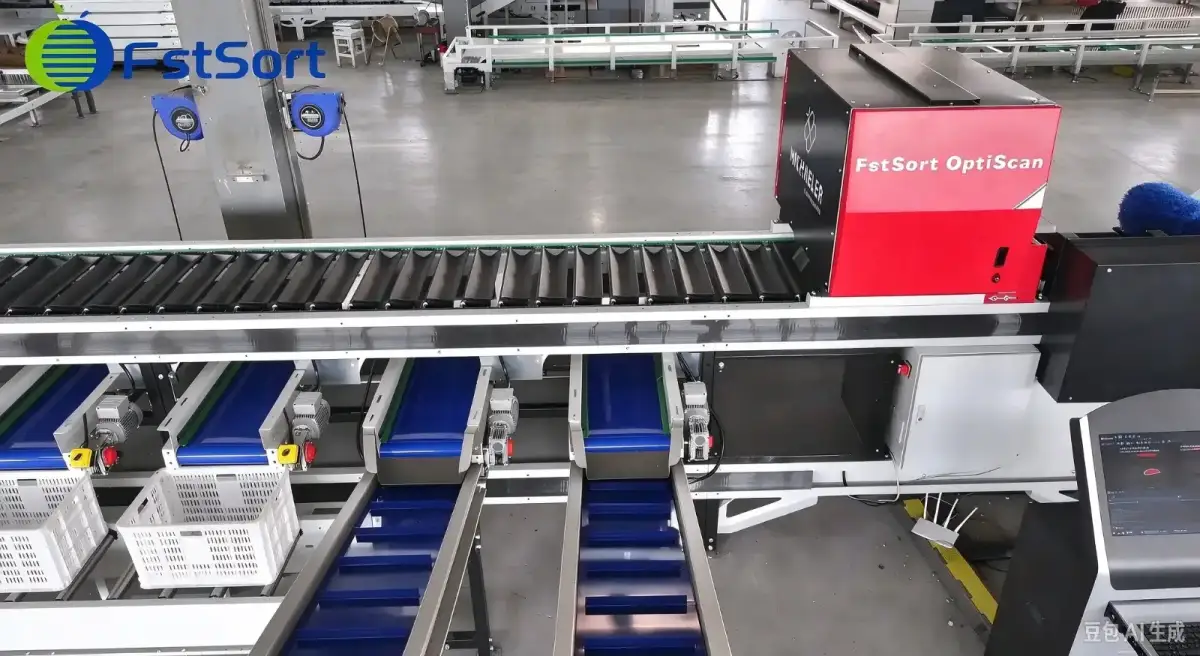
Optical sorting uses high-resolution cameras and spectral sensors to capture size, shape, color uniformity, and defects such as bruises and spots as fruit passes the inspection zone.
Its core value is not "sorting faster," but seeing what the human eye cannot—without touching the fruit. For persimmons that may look perfect outside while browning inside, non-contact inspection identifies damage before it enters the supply chain and meets premium market requirements for internal and external consistency.
But optical sorting carries a higher investment threshold and greater operational demands. It is not a must-have for every processor, but a choice oriented toward a specific market positioning.
Two Methods, Two Different "Risk–Return" Paths
Weight sorting and optical sorting are not "backward versus advanced"—they correspond to two commercial logics:
· Weight sorting: lower investment for specification consistency, accepting some contact risk. Suited to standard markets, budget-sensitive operations, processing or non-very-soft varieties.
· Optical sorting: higher investment for non-contact quality control and defect detection. Suited to premium fresh markets, exports, zero tolerance for browning.
The core question is not "which technology is better," but: at what quality standard and through what channel does your persimmon reach the market? If browning is your biggest after-sales risk, optical sorting prices that risk. If your market mainly demands size consistency on a limited budget, weight sorting is a pragmatic start.
From Sorter to Complete Persimmon Handling Solution
Sorting is just one step in persimmon post-harvest handling. Fstsort's solutions connect sorting with washing, drying, and packing to form a continuous flow from infeed to finished product, reducing handling and secondary contact.
Competition in persimmon exports is shifting from "having supply" to "whether browning is present on arrival, and whether specifications are consistent." When mechanical injury is a leading cause of post-harvest loss, contact control and defect detection at the sorting stage directly determine whether the premium can be carried consistently to the end market.
Want your persimmon sorting to find the right line between "contact control" and "defect detection" for your market? Learn more about Fstsort's sorting solutions→