

Sweet potatoes have thin, delicate skin, and losses during the grading stage can reach as high as 20–50%. Rising export volumes demand greater grading precision. This article explains how Fstsort's roller grader uses its core design—"gradually increasing roller gaps"—to accurately sort sweet potatoes by diameter, replacing human judgment with physical principles and helping processors reduce losses and improve export grades.
The Global Sweet Potato Market Is Growing Steadily
Sweet potatoes are a major global food crop and trade commodity. The global sweet potato market was valued at approximately $34.9–$51 billion in 2025. On the export front, the United States is the world's third largest sweet potato exporter, with annual export value exceeding $160 million. Egypt's sweet potato exports reached 355,069 tonnes in the 2024/2025 season, up 54.1% year-on-year—with exports to Germany growing 72%.
This continued export expansion is pushing sweet potato growers and processors worldwide to rethink their post-harvest grading operations.
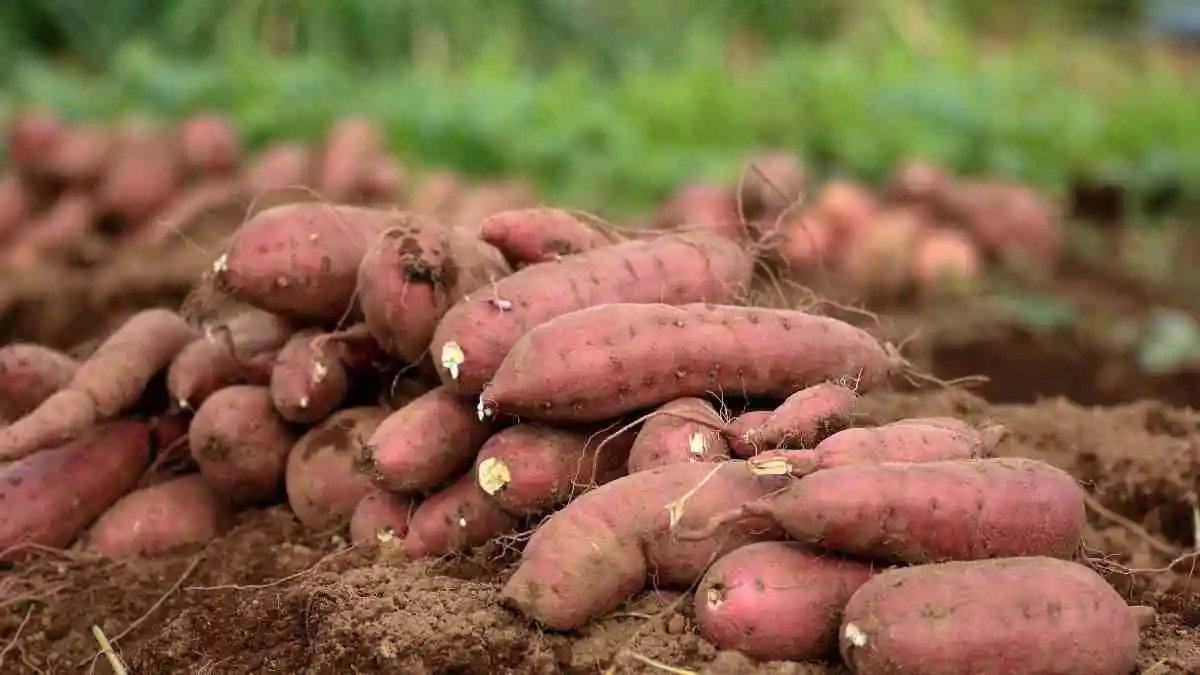
Sweet Potato Grading: Deceptively Simple, Surprisingly Complex
Sweet potato grading is far more challenging than it appears.
1. Sweet potatoes are easily damaged. Sweet potatoes have thin, delicate skin and are highly sensitive to mechanical damage. Bumps and friction during harvesting, handling, and grading all leave marks on the skin. Studies show that post-harvest losses from harvest to grading can range from 20% to 50%. These injuries are not just cosmetic—damaged skin becomes an entry point for bacteria and fungi, leading to shorter shelf life and rot during transport.
2. Manual grading is slow and inaccurate. In many sweet potato producing regions, grading is still done by hand—workers rely on experience and visual judgment. Manual grading is not only slow but also error-prone. Research shows that machine vision systems can achieve 92.6% grading accuracy, significantly higher than manual grading.
3. Inconsistent sizing means good produce can't command good prices. International buyers demand strict size consistency—uniform sizing and intact appearance. Inaccurate sorting means good and defective produce are sold together, directly diluting value.
Roller Grader: A Simple Yet Ingenious Design
It is precisely in this market environment that Fstsort's roller grader was developed. The core design philosophy can be summed up in one sentence: replace human judgment with physical principles.
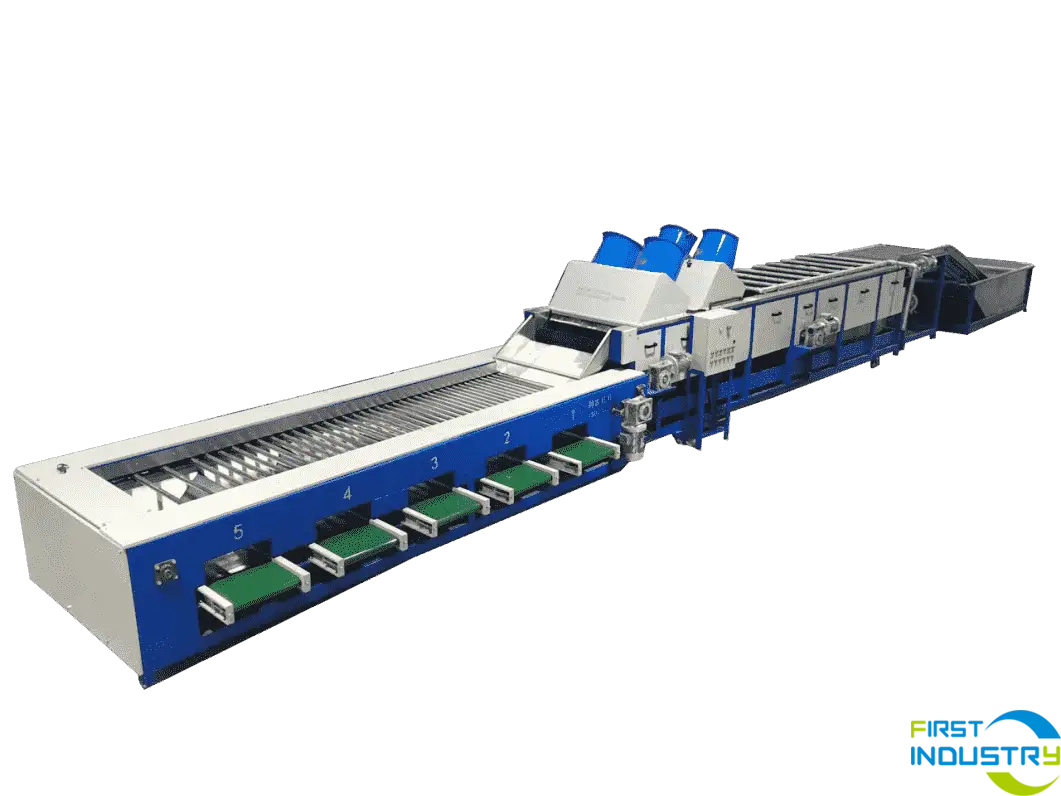
How it works: gradually increasing roller gaps
After washing and drying, sweet potatoes enter the grading section. The grading section consists of two conveyor belts moving in the same direction, equipped with numerous stainless steel roller pipes. The key design feature is this: the gaps between rollers gradually increase from the inlet to the outlet.
As sweet potatoes move forward on the rollers, smaller ones fall through the smaller gaps naturally, medium-sized ones fall when the gaps widen to the right size, and the largest ones travel all the way to the end before dropping. The entire process requires no human intervention and no electronic sensors—it relies on the physical dimensions of the roller gaps, not on human eyes or experience.
Why is this design particularly friendly to sweet potatoes?
Sweet potatoes have thin, delicate skin and cannot tolerate rough handling. The roller grader's advantages are precisely:
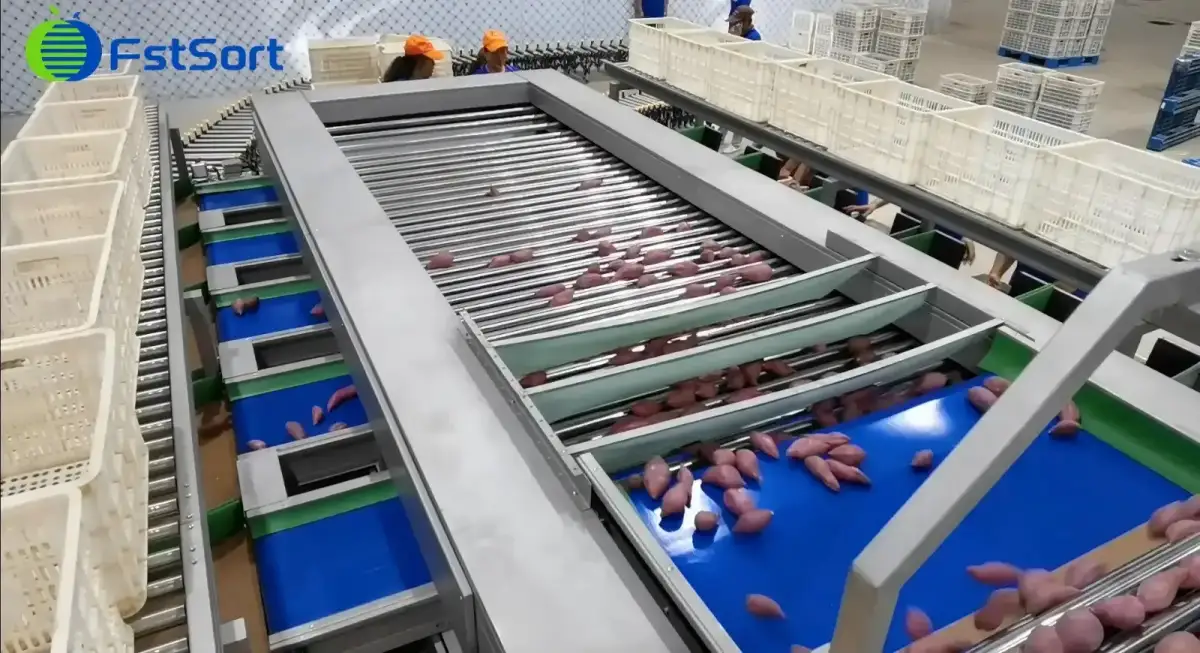
· No skin damage. Sweet potatoes roll forward on the rollers rather than being squeezed or pinched. The roller surfaces are smooth and won't scratch the skin.
· No downtime. The machine runs continuously, processing several tons per hour—far beyond what manual labor can achieve.
· No errors. The physical dimensions of the gaps are fixed—a 40mm gap won't drop a 45mm sweet potato, but a tired worker might make that mistake.
A simple analogy: Think of it as a set of sieves with gradually widening holes—the smallest stones fall through first, the largest stay to the end. Except here, rollers replace the sieve mesh, sweet potatoes replace the stones, and the "hole" spacing changes continuously along a single line.
From Grading to Complete Processing Solutions
Grading is just one link in sweet potato post-harvest processing. Fstsort offers complete sweet potato processing solutions covering from feeding, washing, drying, grading to packaging—all modules can be flexibly configured based on fruit characteristics and target market requirements.
Competition in the global sweet potato export market is intensifying. The US remains a top exporter, while Egypt is experiencing explosive growth in Europe—the precision and efficiency of the grading stage are becoming critical determinants of export competitiveness.
Learn more about sweet potato processing machine→