
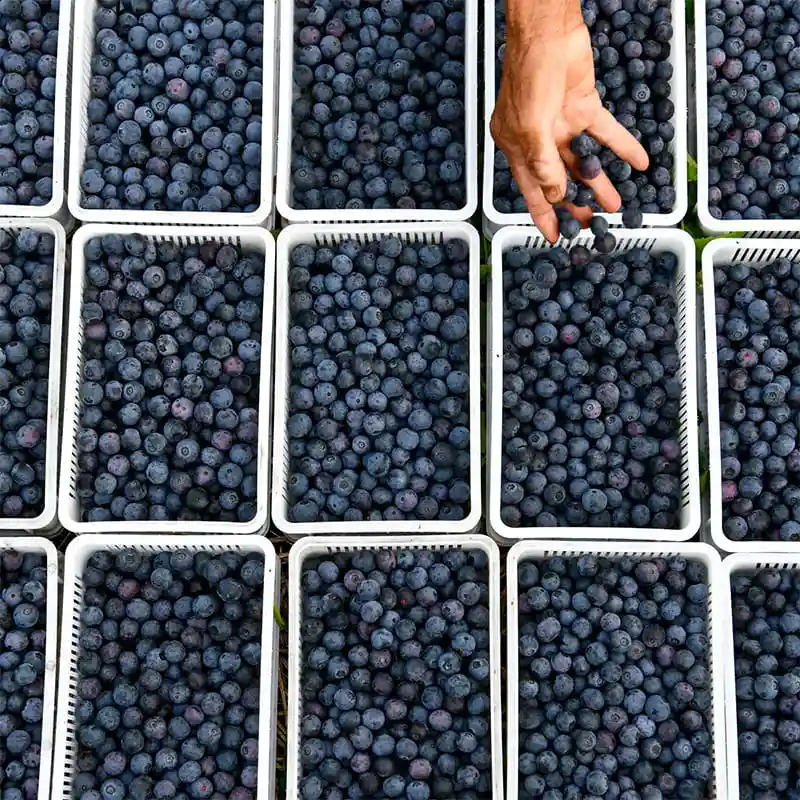
Grading blueberries accurately and quickly requires the right balance of speed, gentleness, and precision. This guide covers the complete process: leaf removal, manual defect sorting, diameter-based sizing (custom holes from 14mm to 22mm), and automatic punnet packing for retail-ready 125g, 150g, and 250g clamshells. A multi-head weigher fills each punnet with ±2g accuracy at 35–50 packs per minute. Fstsort’s blueberry graders feature low-drop heights and soft contact surfaces to preserve the natural waxy bloom and extend shelf life. Solutions available for small farms (drum graders 300–500 kg/h) and large packhouses (belt graders up to 1 t/h).
Do you know how to grade blueberries accurately and quickly without damaging the fruit? Freshly picked blueberries will have many branches and leaves. Before grading, you need to clean the leaves of the blueberries, and then select the damaged blueberries. During the sorting process, you must pay attention to protect the blueberries from being damaged. This sounds easy, but in practice, it's a very complicated thing indeed.
Blueberries are among the most delicate fruits in commercial agriculture. Their thin skin, high moisture content, and natural waxy bloom make them particularly vulnerable to mechanical stress. Proper grading is not just about sorting by size—it's about maintaining fruit quality from the moment of harvest to the final retail package.

Why accurate blueberry grading matters
When you grade blueberries accurately and quickly, you achieve several critical outcomes:
Uniform ripening profile – Consistent sizing ensures that berries in the same package share similar taste and texture characteristics
Extended shelf life – Properly graded and handled blueberries can maintain freshness for export markets or long-term cold storage
Premium pricing – Retailers and consumers expect and pay more for uniformly sized, high-quality fruit with intact bloom
In commercial blueberry packing operations, the grading process must balance speed, accuracy, and gentleness—a difficult combination to achieve without the right equipment.
Key steps in the blueberry grading process
Step 1: Cleaning and pre-selection
Freshly picked blueberries often contain branches, leaves, and other field debris. Before any grading can take place, this material must be removed. FstSort's blueberry grading machine includes a stainless steel fan on the fruit picking table, which can blow off the leaves on the skin of freshly harvested blueberries. The fruit picking part has 2.6 meters and 4 meters to choose from. Workers can stand on both sides of the machine to collect bad fruits. Between the fruit picking part and the grading part, there is a stainless steel connecting plate for falling leaves and small, light waste—this design ensures that debris is filtered out before it reaches the grading stage.
Step 2: Diameter-based size sorting
The grading part is composed of a roller and a belt. The roller is made of manual grinding, and the gap between the roller and the belt is small, which will not cause damage to the blueberries. For high-volume operations, Fstsort also offers belt-type blueberry graders that use a gentle low-drop system to sort blueberries by diameter with exceptional accuracy.
Step 3: Weighing and punnet packing (plastic box filling)
After grading, the final step is packing the blueberries into consumer-ready containers. In the fresh market, blueberries are almost always sold in small plastic boxes called punnets or clamshells. Common pack sizes include 125g, 150g, and 250g per punnet, depending on retailer requirements.
Modern packing operations use an automatic punnet packing machine (multi-head weigher) that:
Automatically drops empty punnets onto a conveyor
Precisely fills each punnet to the target weight (e.g., 125g)
Closes the lid or seals the container
Outputs 35–50 packs per minute
This automated "fill & weigh" system ensures consistent pack weights, reduces product giveaway, and minimizes labor costs. Fstsort offers integrated packing lines that connect directly to our blueberry graders for a complete from-sorting-to-packing solution.
How to grade blueberries quickly without sacrificing quality
To grade blueberries quickly at commercial scale, packers rely on automated grading machinery. The key is to select the right equipment for your operation.
For small farms and entry-level operations: A 2-grade blueberry machine requires only one roller and occupies a small area, saving space. Compact drum graders (300–500 kg/h) are ideal for smaller packing houses.
For medium to large-scale packers: Belt-type graders offer higher throughput, with capacities reaching 1 ton per hour or more. These systems feature quick-release interchangeable belts, allowing operators to switch sizing specifications in minutes.
👉 Looking for a blueberry grading machine that balances accuracy and gentleness? Explore Fstsort's blueberry grading solutions →
Common grading specifications for blueberries
The industry typically sorts blueberries into size grades based on diameter. Fstsort offers customizable sizing holes to match your market requirements. Common hole sizes include:
Grade | Diameter Range | Market Application |
|---|---|---|
Small | 14–16 mm | Processing, some retail |
Medium | 16–18 mm | Standard retail, supermarket |
Large | 18–20 mm | Premium retail, export |
Jumbo | 20–22 mm | High-end export, specialty |
Other sizes (e.g., 13mm, 24mm) are available upon request. Grading holes are fully customizable.
Fstsort's blueberry grading machines feature adjustable sorting speeds and grading sizes that can be customized according to your raw material and market requirements. The grading holes are fully customizable—whether you are processing wild blueberries or larger varieties like Duke or Draper, specific hole diameters can be provided.

Gentle handling: the key to preserving blueberry quality
The biggest risk in blueberry grading is damage to the natural waxy bloom—the white coating that consumers associate with freshness. Aggressive grading can rub off this bloom, causing the fruit to appear dull and shortening its shelf life.
Fstsort's equipment is engineered specifically for delicate berries:
Low-drop height design at every transition point—from feeding hopper to collection outlets, blueberries slide gently rather than falling
Special brushes inside drums to prevent berries from getting stuck
Soft materials at all connection and drop areas to ensure no bruising
Food-grade belts that minimize friction
If you are a small farm grower, you can also consider our standard blueberry grading machine. Welcome to consult!
Complete blueberry processing line: from grader to punnet packer
For packers who want a fully automated solution, Fstsort offers an integrated blueberry grading + packing line:
Feeding hopper & elevator – Gentle transfer into the grader
Drum or belt grader – Sorts blueberries by diameter into multiple sizes
Multi-head weigher – Automatically fills punnets (125g, 150g, 250g) with ±2g accuracy
Automatic box dropper & lid closer – Seals the punnets for retail
Checkweigher & labeling (optional) – Final weight verification and label application
This integrated solution saves labor, ensures consistent pack weights, and protects fruit quality from start to finish.